
Category Archives: Unnecessary diagnostics

Medical lab owners, doctors plead guilty to bogus lab specimen scheme

Newcomers to Shayna’s List often find it difficult to believe that the veterinary industry could have pockets (or worse) of deceptive, if not outright corrupt practices.  Upon perusing some of the articles here, and digging a bit deeper, they usually begin to realize that there is something seriously amiss in a profession that enjoys a virtually unblemished reputation for honesty and compassion.

The medical profession enjoys a similar reputation, nowhere moreso than in regards to the doctors in one’s hometown.

But if one lives in New Jersey, they may have heard of a massive scam among doctors who were bribed to prescribe unnecessary bloodwork, for the benefit of Biodiagnostic Laboratory Services LLC.  Until this disclosure, one of the doctors was heralded for his many charitable and civic virtues.

According to Law360 (emphasis added):

A New Jersey doctor pled guilty on Wednesday to charges that he accepted tens of thousands of dollars in bribes to refer patients to Biodiagnostic Laboratory Services LLC, part of a yearslong scam run by the lab and its president, according to prosecutors.
Dr. Glenn R. Leslie pled guilty to one count of criminal bribery before U.S. District Judge Stanley R. Chesler. Leslie admitted that from August 2010 to December 2011, BLS paid him $5,000 a month for his promise to refer patient blood specimens to the lab. The $85,000 in bribes generated about $380,000 for BLS from private patients and Medicare, according to prosecutors.

Leslie is the 21st participant who has pled guilty in BLS’ scheme bribing doctors for millions of dollars to send business to BLS, which took in more than $100 million from Medicare and private insurance companies, according to prosecutors. Including Leslie, 11 employees or associates of BLS and 10 physicians have pled guilty.

“Dr. Leslie is extremely remorseful for his conduct in accepting illegal referral fees in exchange for sending blood tests to the lab,” Leslie’s attorney, Michael J. Beatrice, told Law360, “His service to the community as a physician, as chamber of commerce president, as police physician and in other charitable endeavors has otherwise been exemplary.” […]

Federal agents in April also arrested BLS owner David Nicoll, his brother Scott Nicoll, who was a senior BLS employee, and Craig Nordman, a BLS employee and the CEO of Advantech Sales LLC, an entity used by BLS to make illegal payments, in connection with the bribery scheme. They pled guilty in June to one count of conspiracy to violate the Anti-Kickback Statute and the Federal Travel Act and one count of money laundering, according to authorities.

The Nicolls admitted to using shell entities to bribe doctors with cash or lease, service or consulting agreements. The goal was to drum up blood sample referrals for BLS and convince doctors to order unnecessary tests on those specimens, according to authorities. To sweeten the deal, some doctors received a fee per test to entice them to send more business to BLS, the defendants acknowledged.

David and Scott Nicoll respectively agreed to forfeit $50 million and $25 million.

NJ.com described how the owners of Biodiagnostic Laboratory Services got to live large as a result of the pathological fraud they were able to perpetrate, thanks to doctors’ complicity:

He dropped $154,000 at a gentlemen’s club and tooled around in Ferraris, Corvettes and private jets. He bought a $700,000 home for his “female companion” and nearly $400,000 worth of tickets to sporting events, authorities say.

That’s how David Nicoll, president and part-owner of Parsippany-based Biodiagnostic Laboratory Services, allegedly spent some of the ill-gotten gains he received from bribing doctors to refer patients and prescribe unnecessary tests, U.S. Attorney Paul Fishman said this afternoon. […]

“People depend on their doctors to make medical decisions about care based solely on medical need,” Fishman said during a press conference in Newark. “When doctors order extra tests or choose particular labs in exchange for cash, they abandon their obligation to their patients … No patients should have to worry that their doctors’ loyalty and judgement have been bought by a salesman trying to make a buck.”

A-freakin’-men.

Do you still think that the veterinary industry is somehow immune to these kinds of scams?   If so, then you really need to rethink whether or not you are prepared to be an effective dog parent.

On a happier note (for the honest, and the taxpayer), David Nicoll’s prized collection of ultra-rare American muscle cars is going to be auctioned off on September 12, 2014, to help reimburse victims of the scam – including Medicare.   One example: a Plymouth Road Runner Superbird 426 Hemi, with an estimated value of $150,000.  Say buh-bye, Mr. Nicoll:
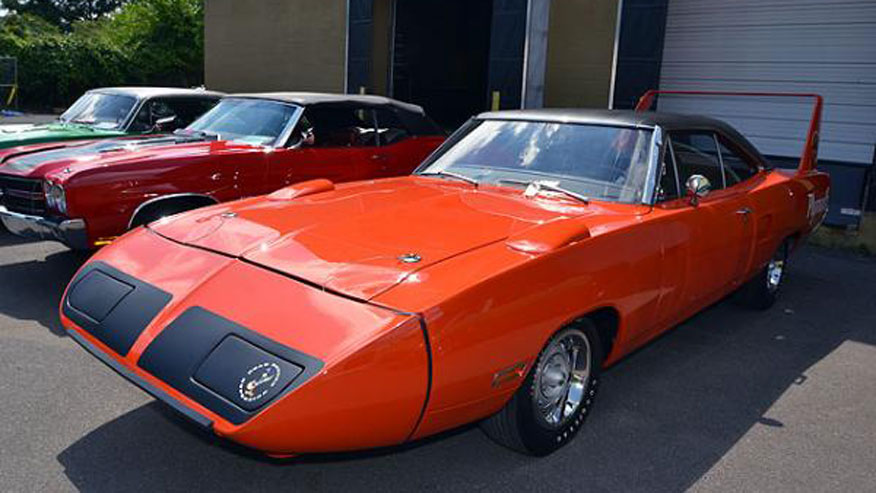
blood-money-bird.

.

.

.

British vet: “Do vets overcharge?”

That question was the title of an article by Joe Inglis, DVM, a British veterinarian.  His answer:

Vets overcharging is a very common concern amongst pet owners, and one that as a vet I am really worried about too – I hear enough stories of owners feeling ripped off to know there is a real problem out there. I have also experienced a culture of what can only be described as profiteering in several practices over my years as a vet, where vets are pressured into recommending additional tests or procedures on very dubious clinical grounds simply to push up profits for the practice owners.

I remember in one of the first practices I worked in being told not to dispense courses of tablets on a first consultation, even if I felt it was the right thing to do, because it was much more profitable to get the owner back for a second appointment and then dispense the treatment. I felt very uncomfortable with this approach back then, and ever since I have become more and more angry at the way in which practices are increasingly focussed on profits rather than pets.

My view is that vets should do what is right for the pet and pet owner not what is right for the vet and their bank balance. Of course vets have to earn a living and I’ve got nothing against practices operating in a profitable manner, but I don’t believe that this can be only be done by vets acting more like pushy used car sales people than caring professionals. I think there is another way, where vets prioritise working with the owner for the best outcome for their pets, taking into account the circumstances and views of the owners rather than simply trying to squeeze as much money as possible out of them.

Later in the article, he cites (and provides proof of) another vet ripping off a patient for nearly $3,000 (US; £1692) for performing an extensive array of diagnostic tests on a dog for… an upset stomach.   Did that vet read this article, in what claims to be the most widely-read veterinary magazine in America, advising vets that 13-25% of their annual revenue should be from diagnostics – and that figure should grow on an annual basis (discussed here)?

Read the rest of Dr. Inglis’s article here.

Of course, there is no blanket answer to the question he asks.  Like physicians, auto mechanics and chefs, all practitioners are different.  But when one considers the data contained on Shayna’s List, and correlates it to the many other sources of similar data on the Web, the fact that overcharging has become a standard practice in many veterinary clinics in the U.S., in Canada, and in England, becomes inescapable.

.

.

.

.

What is driving your vet’s recommendations for diagnostics?

Or more precisely, what is the dominant motivating factor in your veterinarian’s recommendation to perform diagnostic testing – imaging, lab work, or other – on your dog?

If you are an unsuspecting (normal) dog parent, there is only one answer: because your vet believes there is or may be something wrong with your best friend, and the only way to determine this for sure is to perform a specific diagnostic test (or multiple ones).

The reality, unfortunately, may be far different.  And what you’re about to read is just one indication of what I referred to here as the really ugly, unseen underbelly of the veterinary profession.

Take a look at this article by DVM360, a leading veterinary industry publication (click to enlarge):

DVM360 article on diagnostic revenue targets

Let’s start with the title:

How diagnostics drive success in veterinary practice (Sponsored by IDEXX Laboratories Inc.)

Diagnostics “drives success” in veterinary practices?  Does that mean that by providing diagnostic services for dogs and cats whose care and conditions indicate it, one can be more successful?  Nope.  The article begins with what is presumed to be a question posed to a veterinary clinic owner, by his or her professional financial adviser – then two such individuals, Karen E. Felsted (CPA, MS, DVM, CVPM) and Fritz Wood (CPA, CFP) provide the “answer.” (Ed.: Emphasis added)

“Q) What percentage of gross revenue should you expect from diagnostic testing?

“Wood: I would like to see your diagnostic income approach 20% to 25% of your total gross income. And I’d like to see it grow on an annual basis. (See Figure 1 for a chart showing laboratory revenue in well-managed practices.)

“Felsted: If you look at the three published studies out there,1-3 it’s currently somewhere between 13.5% to almost 18% of revenue. If a practice is producing less diagnostic revenue than that, management needs to focus on this area.

Stop and think about that.  A normal person – and pet parent – would assume that a veterinary clinic’s revenues for diagnostic services are generated because the vet(s) have examined the animals under their care and, based on what they observe, advise that certain diagnostic tests be performed.

Now, re-read those “answers.”  They have nothing whatsoever to do with animal welfare – only with a desire to increase the veterinary clinic’s revenues.  Then, imagine you are an honest veterinarian, reading this article.  These professional financial advisers say that if your clinic’s diagnostic revenues don’t measure up to their recommended targets, that you should “focus on this area” – implying, convincing pet parents to authorize diagnostics that their best friends may not need.  Finally, the financial adviser who is listed as a veterinarian (Felsted) says your revenue should be higher than the other’s recommended target – and that this figure should “grow on an annual basis.”

Laughing mechanic

No one wants to envision their veterinarian acting like this. How sad that it is veterinarians themselves who are giving us solid reasons to view them like this.

Think about all that.  Imagine this wasn’t a veterinary publication, but say, one targeting auto service centers.  Now, imagine the publication featured a column by auto service industry financial advisers who openly state that “shock absorbers should constitute 20-25% of your annual revenues,” and that that figure should “grow on an annual basis.”  How soon would it be before a governmental consumer protection agency, or an enterprising investigative journalist, would be sending in undercover customers, to see how many times service centers who subscribe to this publication follow its implied advice – and was recommending that unsuspecting customers pay to have new shocks installed on their cars, whether they needed them or not?

Yet here we have this advice, being openly given on a medical website, DVM360.com, that claims to be “the (veterinary) market’s best read and most respected publications” (hover over the “Publications” circle at that link, or click here for screencap).  It is published by Advanstar Veterinary, which claims DVM360.com is “the leading news website in terms of reach and engagement, serving the entire universe of 155,000 unique veterinarians and teams each month.”

And as an added punch line, the article is sponsored by IDEXX Laboratories, which just happens to be a leading maker of veterinary diagnostic technologies.

Conclusion

So basically, what we have here is an advice column for veterinarians that:

  • Counsels them to (a) aim to generate 13-25% of their annual revenues from diagnostics – regardless of whether their patients actually require these tests – and (b) work to make this figure grow on an annual basis.
  • Is sponsored by a company that just happens to make certain diagnostic technologies, and therefore stands to significantly profit if vets actually follow the advice in this column.

Certain honest veterinarians are now openly stating (example) that if the veterinary profession doesn’t clean up its own act, someone from the outside is eventually going to pull back the veil, and expose the outrageous, profit-driven shenanigans that are being perpetrated by some within it.

News flash: Shayna’s List is going to be that external force that exposes this kind of shameful nonsense.

Do you have a story of similar outrageous conduct by veterinarians, or those who counsel them?  Email me.